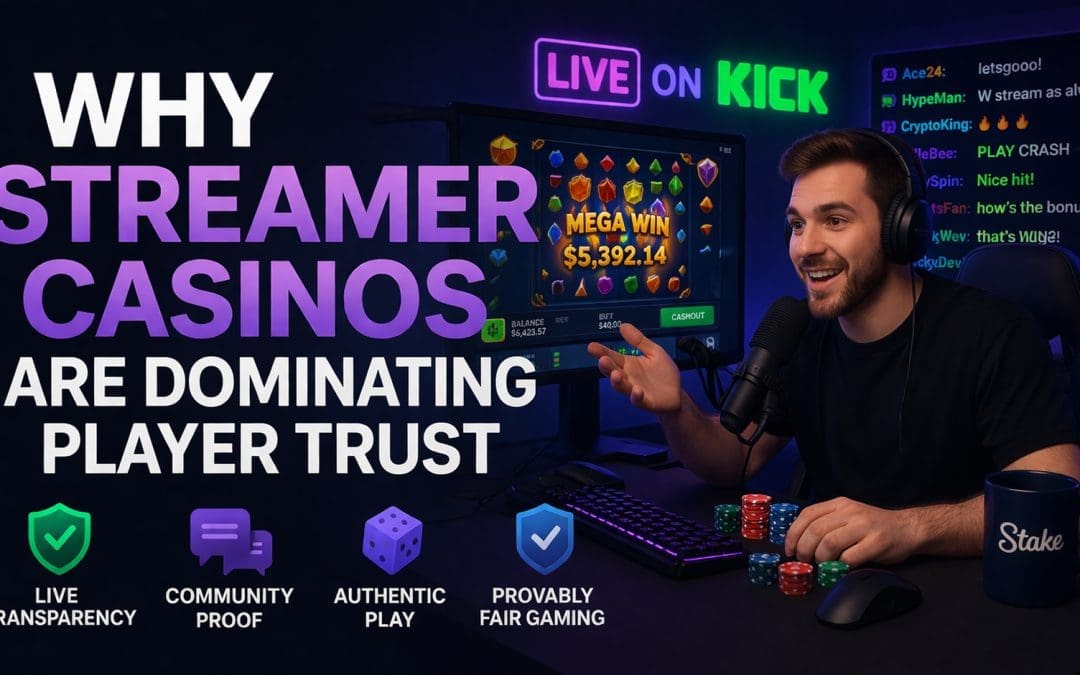
Trust in online gambling has always been tenuous. A casino’s attractive home-page; a large welcome offer; and a lengthy list of available games, doesn’t necessarily lend trust to the players. This is the real reason behind the rise of “streamer casinos”. While they certainly didn’t create trust, nor did they create gambling. What they did was to make trust visible.
In the past, players typically evaluated websites via static signals (e.g. A license badge in the bottom corner of a webpage). However, this method is inherently flawed. For example, a player can find a review article on a specific website that appears to be identical to ten others. Or, he/she can search reddit threads containing comments about the website, which include accusations of being rigged, and responses from fans of the website claiming that it is trustworthy. The old model created a rhythmic expectation. Today, however, players can watch a streamer deposit, spin, lose, win, rage quit, withdraw, and answer questions directly while the streamer is actively engaged in live gameplay. There is little doubt that this type of interaction significantly alters the emotional equation quickly.
Therefore, streamer casinos exist at the nexus of entertainment, social proof, and the demonstration of a product in real-time. These three elements combined create significant power. However, they are also problematic. Many streamers operate with extreme transparency and caution. Conversely, some are completely reckless. Additionally, gambling brands will gain positive benefits from increased scrutiny related to live gameplay. However, other brands will rely on the credibility established by a popular personality and hope that their viewers don’t inquire too deeply regarding potential inconsistencies. Regardless of these reservations, it is relatively simple to determine that live casino streamers currently influence more player opinions than traditional affiliates or advertisement campaigns have previously influenced.
Online casino marketers have continuously battled One obvious issue; i.e., players are being asked to trust outcomes that they cannot witness personally. In a brick-and-mortar casino, a player can observe the dealer shuffling cards, listen to the sound of chips falling onto a table surface, and gauge the reactions of fellow patrons when a progressive jackpot is awarded. Conversely, in an online casino setting, players stare at a computer monitor and pray that a random number generator (rng) is functioning accurately in accordance with specifications published by the manufacturer.
As such, terms including rng certification; Curacao gaming license; Malta Gaming Authority approval; and Provably Fair algorithms provide answers to One of the primary anxieties of players; e.g., “can i trust this?”
However, most players do not review audit reports. Players do not compare various jurisdictions in order to identify the jurisdiction in which a particular online casino operates. Players do not pass several hours reviewing blockchain casino verifications. Rather, players seek human shortcuts; e.g., they desire a trusted face; repetitive exposure; and some indication that what they are viewing is genuine.
At this juncture, casino streaming platforms entered the marketplace and consumed the majority of attention afforded to online casino marketing.
While a streamer is playing on Stake.com; Roobet; Duelbits; or Rollbit, they are providing far more than promotional activity for a casino. The streamer is publicly performing trust for their audience. Their viewers can assess whether games launch properly; whether balance updates occur correctly; whether withdrawals are referenced during a session; and whether the streamer continues to return each evening.
Even though a sponsor relationship exists between the streamer and a casino operator, the experience presented by a streamer is perceived as more open than a standard banner ad.
Players generally do not trust corporate communications easily. Players trust patterns. Players trust repetition. Players trust performance under duress. Casino streaming sites present their viewers with all three of these attributes.
Advantages associated with trust built through streamer casinos
One of the greatest advantages associated with streamer casinos is speed. Traditional advertisers required weeks to complete research. Conversely, viewers can evaluate a casino via a streamer within hours of initial contact.
A player who visits a casino website via a generic advertisement has virtually nothing upon which to base an evaluation. Conversely, when a player views a streamer who played on that casino for three consecutive evenings, they possess additional contextual information. They viewed how bonuses were utilized. They observed whether the streamer continued playing despite experiencing severe losses prior to winning. They witnessed whether support-related issues arose. They listened as viewers asked blunt questions in chat. As such, the casino begins to appear less like an unfamiliar website and more like an establishment with a documented history.
This does not imply that viewers are conducting forensic due diligence. Most viewers are not engaging in due diligence. However, they are forming an intuitive assessment based on visible use. Humans are naturally inclined to perceive busy restaurants as legitimate businesses. Humans are naturally inclined to utilize products that friends utilize successfully. Humans are naturally inclined to utilize tools that they can visually examine without confusion. Streamer casinos benefit from these same tendencies.
Additionally, the same rationale supports why many traditional reviewer evaluations are surpassed by live casino streamer reviews. A written review may describe how a crash game functions smoothly and how quickly withdrawals are processed. Conversely, a live stream provides visual representations of actual betting rhythms; user interfaces; volatility levels; reactions from chat members; and moods exhibited by the streamer during periods of adverse variance. Ultimately, the written review evolves from descriptive language to tangible evidence.
Real-time play provides transparency and feels more honest
Watching live casino play has an undeniable clarity to it. Although viewers recognize that some level of entertainment occurs during the process of creating a video intended for consumption, real-time gambling reveals aspects of processes that polished marketing efforts attempt to obscure.
For example, if a slot session is streamed for two hours it displays extended droughts in winnings. Conversely, if an individual participates in crash gambling and streams their experiences for hours on end; it will illustrate precisely how rapidly excessive greed can negatively affect timing choices. Finally, if an individual participates in live-dealer blackjack and streams the experience, it illustrates table speeds, actions taken by dealers; and enticements for side bets in a manner that is impossible to visualize through screenshots.
Ultimately, players absorb all of this information without needing to read One instructional manual.
Therefore, it is no surprise that live casino streaming generates such high levels of impact on player trust metrics. Real-time play converts abstract promises into direct observations.
Several characteristics differentiate effective streaming models from ineffective ones. first and foremost, effective streaming models display players’ balances clearly. Secondarily, effective streaming models rarely delete losing sessions entirely and/or allow them to remain intact throughout their entire duration. Thirdly, effective streaming models have their creators explain their decision-making surrounding betting selections as opposed to acting as though each spin is predetermined. Fourthly, effective streaming models notify viewers when promotions contain sticky features or when wagering requirements become onerous or punitive. Fifthly, effective streaming models inform viewers when promotions lack substance or represent thinly veiled advertisements for alternative offerings.
All five aforementioned elements contribute to building credibility among viewers regardless of their existing degree of skepticism towards advertised opportunities.
Similarly, while viewers know that a given streamer has accepted compensation from a casino provider prior to accepting viewership dollars; the actual streaming experience presents greater insight into both intentions and capabilities compared to any amount of corporate-generated buzz or static advertising media.
Ultimately, it is irrelevant whether or not sponsorship destroys credibility. Hidden agendas destroy credibility immediately. Therefore, when adequate amounts of on-screen honesty accompany adequate amounts of sponsorship transparency; then viewer perceptions regarding credibility are enhanced beyond what was possible via static advertising formats.
Audience influence exceeds operator recognition
The trust generated amongst streamer casinos extends beyond the creation itself. Audience participation plays an equally significant role in generating trust.
Streaming chat represents a chaotic atmosphere filled with banter and often absurd commentary. However; it serves as an ongoing form of public auditing.
Somebody asks whether the streamer uses house funds in addition to personal funds. Somebody else asks if there are regional restrictions placed upon bonus offers. Yet another viewer expresses displeasure regarding delayed payments made toward withdrawals on separate occasions. Yet another viewer shares their personal experience regarding Roobet or Duelbits in chat. Over time, these fragmented pieces develop a communal reputation layer.
Therefore, when considering gambling community-generated trust as a viable resource; it provides players with new avenues for assessing multiple facets of an online casino simultaneously.
Prior to this model’s existence; players assessed online casinos in isolation. Presently, players assess online casinos within the confines of social environments where experiences are exchanged in real-time. A single stream with thousands of concurrent viewers establishes an evaluative feedback loop that traditional forms of affiliate content can never replicate. The streamer states something concerning a particular aspect of an online casino operationally or financially. Chat either validates or contradicts this assertion and viewers adjust their overall perception accordingly in real-time.
The differences between this model and Twitch’s gambling content model are evident in the platform’s policies governing gambling content; advertiser pressure applied toward Twitch’s policy makers; and the resulting negative publicity directed toward Twitch’s gambling content providers led to a decline in the ability for Twitch-based gamblers to promote sponsored relationships with casinos openly via live-streamed events. Alternatively; Kick provided its gambling-based content creators with more freedom thereby allowing them to generate more streams; repeat exposure to casino logos; and more opportunities for consumers to establish familiarity with select branded casinos.
These dynamics ultimately have an impact on how visible casino operators remain once exposed to scrutiny in public forums.
Consequently; when authentic representations exist, polished forms of advertising consistently fail.
Gambling audiences recognize fake enthusiasm quickly. Players realize when they are being sold something when they are witnessing false cheerleading from an entertainer or influencer. Similarly, viewers perceive excessive bravado as indicative of ulterior motives (i.e., attempting to sell something).
Ultimately; authenticity trumps polished representation in every instance.
Therefore; authenticity-based approaches toward communicating with gambling audiences via live-streamed casino content matter greatly. Authenticity is characterized by acceptance/acknowledgement of mistakes made by streamers. Acceptance/admission of uncertainty/doubt by streamers. Humor exhibited by streamers when encountering poor run-of-form/table performance/timing. Admission by streamers that they are “chasing” during periods of prolonged losing sequences/cycles/epochs/etc… Identification/exposure by streamers of bonus buy practices/unattractive bonus buy practices/sticky bonus conditions/wagering requirements/bonus limitations/promotional gimmicks/etc.. Statements from streamers indicating that certain slots games have stopped paying/offered minimal returns/dead/ etc… All of these examples provide evidence of imperfect honesty and therefore contribute to establishing credibility with gambling audiences.
Trainwreckstv has emerged as One prominent example within this context primarily because his streams embodied raw emotion as opposed to polished production quality. Regardless of whether or not viewers liked trainwreckstv or hated him; the sheer intensity conveyed during his live gaming sessions created an impression that he was experiencing genuine emotions during play versus scripted behaviors designed solely to sell something.
Similarities exist between big-name personalities associated with xQc’s gambling clips and Adin Ross’ casino discussion sessions (and potentially others). Similarities exist between big-name personalities associated with xQc’s gambling clips and Adin Ross’ casino discussion sessions (and potentially others). Entertainment-based appeal attracts viewers initially; whereas the sensation of instantaneous engagement maintains interest long-term.
Paradoxically: sponsorship alone does not preclude trust-building capacity among viewers. Concealment (Hidden agenda) destroys trust immediately.
Most viewers are aware when they are viewing sponsored content (although not necessarily when they receive compensation). Most viewers can distinguish between genuine attempts by entertainers/influencers to communicate honestly regarding their involvement with sponsored content/products/services and those individuals who have compromised their integrity in exchange for remuneration.
When both sincerity and transparency coexist relative to sponsorship agreements/involvement; then entertainers/influencers generate credibility through sponsorship-based endeavors that surpasses traditional static-advertisement formats.
Provably Fair technology facilitates better understanding among audiences
To numerous players “Provably Fair” technology represented marketing jargon authored by technical professionals for other technical professionals. Provably Fair technology represents an important technological advancement specifically for cryptocurrency-based platforms and crash-game style gambling products. However, typical consumer participants will neither manually check seeds nor investigate hashing methodologies following dinner.
Live streaming helps translate Provably Fair technology into something consumers can intuitively understand
When a live-streaming gamer describes how Provably Fair algorithms function during real-time gameplay while illustrating how results can be verified temporarily; the feature ceases to be abstract in nature.
When gamers demonstrate Provably Fair technologies as part of their real-time gameplay experiences; they convey mechanisms for verification of randomness/sequence generation (etc.) to their viewers which further reinforces their confidence in utilizing those technologies to generate credible randomness/sequences/numbers/etc…
Regardless of whether or not most viewers independently validate each result; live-streaming demonstrable Provably Fair gaming establishes literacy among consumers regarding these types of systems. Literacy enables consumers to formulate questions regarding competing products/systems. Literacy facilitates comparative assessments between competing products/systems which collectively enhances online-casino credibility.
We’ve come full circle
There are certain names that continue to surface in conversations regarding the popularity of casino streamer platforms. Stake.com has emerged as nearly impossible to avoid within this discussion due to its success in leveraging both aggressive creator relationships and high volume streaming practices. Similarly, Roobet, Rollbit and Duelbits have gained prominence through their exposure in the casino streaming community and within the realm of cryptocurrency gaming. A user may not recall viewing a license agreement, but they likely will remember seeing the same casino platform featured throughout various streams, clips and community chatter for extended periods.
While this does not inherently signify that these are the top rated casino streamer platforms for 2026; the previous statement is accurate. The mere fact of having a significant amount of visibility does not equate to a safe environment for users. A sponsor’s level of outreach is no indicator of providing a higher level of protection to users. However, familiarity (i.e. Being exposed to) a particular brand multiple times increases the likelihood that users will associate it with reliability.
Ultimately, the trust that users exhibit towards casino streamer platforms stems from numerous overlapping factors. These include:
- the casino platform’s presence on popular casino streaming channels.
- the creator appearing to be comfortable in featuring real time sessions on said channel.
- active discussions surrounding the use of bonuses and limitations within chat areas.
- Honest explanations regarding Bonus offers and any applicable restrictions based upon geographical location.
- games responding in a manner consistent with expected behavior.
- an easily understood description of the licensing structure used by the casino platform that prevents widespread panic amongst the audience.
These combined elements contribute to the sense of trust that users develop when using a casino platform. Furthermore, since users typically cannot independently validate all technical aspects of a casino platform, this collective sense of trust plays a vital role in creating a trusting relationship.
Promotions, bonuses and credibility
Promotions and bonuses offered by casino streamer platforms serve as two of the most effective methods for building and/or destroying trust with users.
An exclusive promotion provided specifically to members of your community can provide a personalized feeling for your audience. In addition to making the audience feel like they receive something special by participating in your community; it signifies to the audience that you have created an inside track for them. At a fundamental psychological level, people trust offers that they receive directly from individuals they follow more than general promotional offers displayed on a homepage to everyone.
However, there exists an inherent danger associated with providing promotions/bonuses to your community. Many promotions/bonuses presented by casino streamer platforms appear attractive at first glance and ultimately fail once wagering requirements, game restrictions, geo-restrictive provisions and/or low cash out ceilings become apparent. As such, when a streamer avoids discussing these points, it creates dissatisfaction amongst your audience. Moreover, dissatisfaction created by avoiding discussion regarding specific issues related to promotions/bonuses extends beyond the actual promotion/Bonus itself and extends into the overall credibility of the streamer and the casino itself.
The streamers who maintain trust with their communities long-term typically view bonuses/promotional offers as products requiring detailed descriptions/explanations. Typically, these types of streamers describe when codes for promotions/bonuses are available however, are limited. Likewise, they describe when reload offers are better suited to meet individual needs compared to sign-up packages. Finally, they acknowledge when promotions/bonuses are primarily designed to entertain rather than provide substantial advantages to their audience. While this type of transparency may generate less excitement during the initial phase; transparency promotes development of trust with adult gamers who have previously experienced similar negative experiences.
Risks are real – trust can turn dangerous quickly
As stated above, this entire ecosystem contains dangers that do not receive sufficient serious consideration. Trust provides benefits when it enables users to select more transparent casino operators. Conversely, trust serves as a hindrance when it reduces a user’s skepticism. Watching a charismatic creator engage in gambling can cause users to perceive risk as social, manageable and/or acceptable. Ultimately, watching a charismatic creator gamble can create blurred lines between entertainment and recommendations. Specifically, a user who would never respond to a standard advertisement for gambling may elect to deposit funds as they perceive their favorite streamer as familiarizing them with the site and creating an enjoyable experience. This represents a form of considerable influence – particularly on younger demographics or impulsive gamblers.
Additionally, streamer casino platforms can adversely affect perceptions. Streaming formats favor extreme events. Big wins produce dramatic clips. Harsh losses produce dramatic stories. Bonus buy rounds create spectacular content. None of these formats accurately depict how most regular players should handle gambling or depict long term sustainable bankroll management strategies.
Therefore, several safeguards represent greater importance than most people realize:
1\. The streamer clearly discloses his/her sponsorship arrangement(s).
2\. The streamer honestly describes terms/conditions of promotions/bonuses and explains any geo-restrictive provisions.
3\. The streamer displays evidence of reasonable responsible gaming options/tools, limits/cooldowns.
4\. The streamer provides Clear and concise information regarding its licensure and/or verification processes.
5\. The streamer does not portray entertainment sessions as representative examples of actual player results.
If these five conditions exist, the sense of trust created through streamer casino platforms will resemble theater. Theater is not an appropriate basis for real-money decisions.
Why traditional casino affiliates are struggling to compete
Many older school affiliate content continues to read as though it was developed from the same toolbox of interchangeable parts. “quick payouts.” “extensive game library.” “trusted online casinos.” “secure experience.” This is not necessarily inaccurate; however, it is generally unconvincing today. Users have seen too much.
Users currently desire proof with substance. Users desire to witness a streamer becoming enraged after twenty consecutive dead spins. Users wish to listen to someone explain why one live dealer lounge seems cleaner than another. Users desire to witness the awkwardness. How quickly did support answer? Did the application freeze? Were VIP awards truly valuable or simply superficial?
Streamer casino reviews do not always address these concerns adequately; however, they convey a lived-in quality that is difficult for static affiliate websites to match. Therefore, many static affiliate websites are experiencing diminishing influence — even when they remain highly ranked within search results.
The new economy of credibility favors those who show rather than tell.
The next wave: metaverse casinos, social layers and always-on-trust
The future of this space will not be simply additional streams. It will be more social infrastructure surrounding gambling itself.
Decentraland metaverse casinos represented an early indication of this trend – despite the subsequent cooling of interest in the broader metaverse phenomenon. What made decentraland interesting was not the virtual real estate per se; it was attempting to transform online gambling into a location where people interact collectively rather than merely transacting privately on a website. Since streaming fits naturally into this format, the more social gambling becomes; the more trust will derive from shared visibility, communal validation and ongoing mediator roles of creators.
You can already begin to observe indicators of which direction trends are moving. Hybrid formats are gaining momentum. More social casino videos are emerging that incorporate clips, reactions and live commentary. More player-engagement streams are being generated that utilize chat-based decision-making processes and community-challenges. Verification tools are being integrated into more formats — particularly those that allow creators to display evidence of such functionality in real-time. Cross-over models between entertainment figures/personalities and gaming companies are increasing.
This will create additional opportunities while simultaneously creating larger risks. Long-term successful casinos will not be the ones who promote themselves louder. Instead, long-term successful casinos will be those that prove compliant consistently through repeated public scrutiny. Successful casinos will require enhanced protections/safeguards, more transparent compliance standards and fewer gimmicky designs intended to mask lackluster compliance standards.
Gamblers are growing smarter. Gamblers still seek thrills; however, they are increasingly able to rapidly compare notes with others. If a casino platform appears questionable to users; they will share their doubts via the community forum/chatter area. If a creator appears insincere/disingenuous; users will migrate away from that creator/stream. If a casino platform provides excellent design features; demonstrates fairness through multiple venues; and if the creator appears authentic/trustworthy; then users will establish trust with the casino platform rapidly.
This is essentially the entirety of this article in one sentence: casino streamer platforms dominate player trust due to their ability to create credibility through live, social and verifiable means.
Perfectly verifiable? No.
Safely verifiable? No.
Verifiable enough to exceed older established models? Yes