How do online casino sites really work?
Newcomers to the online gaming community know that feeling. You’ve registered, funded your account, and now you’re faced with hundreds of slots, multiple versions of roulette, a handful of live dealer tables, and a whole host of other betting opportunities. Who gave you a user’s manual? Most people figure it out eventually, but there is certainly plenty of money spent along the way while figuring it out. Here we cut through the fluff and look at the underlying mechanics. We’ll cover what happens behind the scenes at the casino, where your deposits go once you fund your account, and what sets a legitimate site apart from a site you’d best get rid of
What is an online casino site?
In essence, an online casino site is simply a piece of software. In fact, it is really a platform for providing various types of gaming opportunities, connecting you to your chosen banking option, and managing your account balance. The games available for play are developed by third-party software companies, licensed to operate on the casino site, and then integrated onto the site. For example, when you hit “spin” on a NetEnt or Pragmatic Play slot machine, you are essentially playing that company’s slot machine game on the casino’s platform.
Why does this matter?
It matters in one fundamental respect: the casino doesn’t actually determine what a given game pays out. The return to player percentage (RTP) is a part of each game’s coding written by the game development firm and validated by an independent laboratory prior to being deployed on any casino site. Therefore, when you see a slot machine listed as 96% RTP, that is directly coming from the game development firm, was validated by the independent laboratory (e.g., eCOGRA or iTech Labs), and the casino cannot alter it. That is great news for players since it indicates consistency across all legitimate sites offering the games.
How do games generate random results?
The most frequent questions asked by new gamers are about rigging. To honestly answer that question requires you to understand the random number generator (RNG).
Each game outcome – including every slot spin, every draw of a card, and every roll of a die – is generated randomly using an RNG. An RNG is a mathematical formula that generates an infinite stream of random numbers at thousands of times per second. Each time you press the “spin,” the RNG has already generated a number that corresponds to a particular sequence of reels. The animation you watch is merely a visual interpretation of results predetermined as soon as you pressed the button.
Independent laboratories test RNG systems. Statistical analysis is performed on millions of simulated hands or spins to ensure that true randomness exists in the game results and that the actual payout percentage matches the published RTP. All certified sites display evidence of such audits somewhere on their website – usually in the bottom section. If you can’t locate any reference to third-party auditing on the site in question, that is something you might wish to investigate further.
How do live casino games produce random outcomes?
Unlike RNG-based games, live dealer games rely on human dealers shuffling actual cards or spinning real roulette wheels inside a television studio. Those feeds are then transmitted via the internet to the gamer in real-time. Studios that produce these streams include Evolution Gaming and Pragmatic Play Live. These studios provide their feed(s) to dozens of different casino operators. As a result, the randomness in live games comes from real-world objects rather than algorithms, which is why so many experienced gamblers prefer live games more than computer-generated ones.

Setting up your account and starting to play
Creating an account at an online casino works similarly to creating an account at any other type of service. There are however several aspects unique to gambling services. You will be required to provide identification details such as your name, birthday, address, and email. Also, you must be of minimum legal gambling age in your country/region. In addition to this most licensed websites will request that you create responsible gaming limits during your initial registration (deposit limits, loss limits, etc.) before you add funds to your account.
Your casino account balances serve as a bank account for your wagers. Anytime you add funds to your account, that amount becomes available in your wallet and is available for placement of wagers. Should you win at a game, your winnings become part of your current balance. If you choose to leave after winning, you begin withdrawing funds from your balance and send those funds back through whatever banking method you originally used. While this sounds fairly straightforward in theory, there are a few technicalities regarding withdrawals that can surprise first-time users.
KYC Verification: Why casinos verify you
At some point after opening your account, likely before attempting to withdraw any wins for the first time, the casino will require documentation confirming your identity (your “know your customer,” or KYC). Typically, KYC will involve providing copies of identification documents (such as your passport or driver’s license), proof of residency (utility bills or bank statements), and possibly even a scanned image of the card used to fund your account. This is not something created by the casino solely to complicate your experience; it is a regulatory mandate connected to anti-money laundering (AML) laws that govern all licensed casino operations worldwide. The smartest course of action would be to comply with any requested KYC documentation at the earliest possible stage – ideally right after opening your account – instead of waiting until you attempt to withdraw any wins.
Adding Funds to your account: Banking options and timing
Banking options are among the most essential components of online gambling services that new users need to understand before they start placing wagers. Most regulated casino sites allow multiple forms of funding, including debit & credit cards (Visa/Mastercard), e-wallets (PayPal/Skrill/Neteller), bank transfer services (Trustly), pre-paid cards (Paysafecard), and cryptocurrency options (Bitcoin/ethereum/etc.). Deposit processing times are nearly instantaneous regardless of banking option selected.
Withdrawal processing times vary
Withdrawal processing times can vary greatly depending upon both your preferred banking option and the policies implemented by the casino itself. For instance, e-wallet withdrawals processed correctly at well-managed casinos typically occur within 24-48 hours. Bank transfer withdrawals can take anywhere from 3-7 business days. Credit/debit card withdrawals tend to land somewhere in between those two extremes. It’s best to avoid any casino that consistently takes longer than that – delayed withdrawals are often indicative of a poorly managed operation.
A banking option trap: limitations on withdrawals
A banking-related trap commonly encountered by inexperienced users involves restrictions imposed by certain casinos on withdrawing funds using only the original banking method used for funding an account. Using our previous example: if you were to fund your account with a card with an associated monthly cap of £2,000 and wished to withdraw £5,000 – you would be required to utilize another approved banking option for withdrawing the remaining £3,000. Prior to adding substantial sums of money into your account – read the withdrawal terms carefully, as they differ far more than you’d think.
Game payout percentages (RTP): understanding without technical terms
Two key metrics quantify precisely how each online casino game functions on average over extensive periods:
Return-to-player percentage (RTP)
House edge
RTP is described as a percentage of how much of every pound/dollar wagered at a game is returned to players throughout millions of plays. A theoretical RTP value of 96 percent for example, means that approximately £96 is returned in winnings for every £100 wagered. The remaining £4 constitutes the house edge – or built-in mathematical advantage enjoyed by the casino. the house edge is thus four percent for this hypothetical slot machine with 96 percent RTP.
Statistical significance only emerges after millions of rounds
During any single session or hand you could conceivably win many multiples more than you initially staked or lose all of your funds rapidly. The RTP tells us what overall return percentage exists for all players collectively across an extended period – not what will transpire during any individual session.
In practice, this translates into greater value inherent in games possessing higher RTP values. Properly-played video poker can exceed 99% RTP. Optimal strategy applied to blackjack yields near 99.50% RTP. European roulette provides roughly 97.3% RTP. However, due to an additional 00 on the wheel American roulette’s RTP falls to 94.74%. Lower RTP slots can drop down below 94%, meaning that at least seven cents are taken by the house for every dollar wagered before you can place your next wager.
Another closely related concept is volatility levels associated with slot machines. Volatility influences frequency and size of payouts on slot machines – but does not influence their long-term RTP percentages. High-volatility slots pay infrequently but pay substantially larger payouts when they do pay out. Low-volatility slots offer lower-payout combinations more frequently. If you possess limited funds in your bankroll, high-volatility slots pose a risk of depleting your entire bankroll quickly despite offering relatively favorable RTP statistics. first-time gamblers with limited funded accounts will generally encounter less frustration when participating in medium-low volatility slots until they develop sufficient knowledge relative to variance in slot gameplay.
Bonuses: What they offer & what they really cost
All new players see welcome bonuses displayed prominently on home pages prior to opening an account. A 100% match bonus up to £200 sounds like free cash! But that description doesn’t reveal everything and One major detail makes all the difference in how attractive they appear: wagering requirements.
Every bonus has wagering requirements (also known as play-through requirements). Those requirements describe how many times you are required to place wagers through any bonus funds awarded prior to allowing withdrawal of any potential winnings from those bonus funds. A £200 bonus with a 30x wagering requirement means you must place £6,000 in wagers prior to converting any portion of that bonus into withdrawable funds. At an average RTP slot machine – expected house-edge losses incurred by converting £6,000 in wagers total approximately £240.
While not all bonuses are terrible offers – wagering requirements vary widely from 10x (exceedingly reasonable) to 60x (virtually worthless). Free spins offers tied specifically to particular slot titles can be valuable should the designated title possesses acceptable RTP figures. No-deposit bonuses issued by casinos wherein no deposit has been required for registration normally feature highly-restrictive wagering requirements – although they do Cost nothing to experiment with.
Bonus terms also outline which games count toward clearing wagering requirements and at what rates. Slots normally count toward clearing wagering requirements at 100%. Many table games (blackjack primarily) typically count at 10% or less due to their high RTP values making it extremely difficult for casinos to prevent players from meeting wagering requirements profitably. If you are primarily interested in playing table games – many welcome bonuses are effectively unattainable even if you meet eligibility criteria based solely on account status.
Licensing: The Foundation of Player Protection
All of the player protection framework builds upon online casino licensing. It’s worth taking a couple of minutes to learn what the primary licenses truly represent. One of the most serious regulatory bodies in the world is the United Kingdom Gambling Commission (UKGC). All casinos regulated by the UKGC will be required to follow very strict guidelines when it comes to ensuring the games offered are fair, providing responsible gaming tools, protecting customer funds, and resolving complaints. In addition to the UKGC, the Malta Gaming Authority (MGA) is also a well-respected regulator in the European market. The Gibraltar Regulatory Authority is yet another regulatory body that provides proper oversight. Curacao eGaming licenses are probably the most common found on newer sites or established sites; oversight is obviously weaker; therefore, the consumer protections are weak too.
There are unregulated websites. Unregulated websites may appear to be professional, and they may even pay out from time to time. If anything happens and you want some form of redress, you’re basically out of luck. There’s no regulatory agency to contact, no player protection fund, etc. The several seconds spent checking a casino’s license at the bottom of the page and confirming it on the regulatory agency’s webpage is literally the best investment you could make before making any type of deposit.
A Quick Guide Through Online Casino Game Libraries
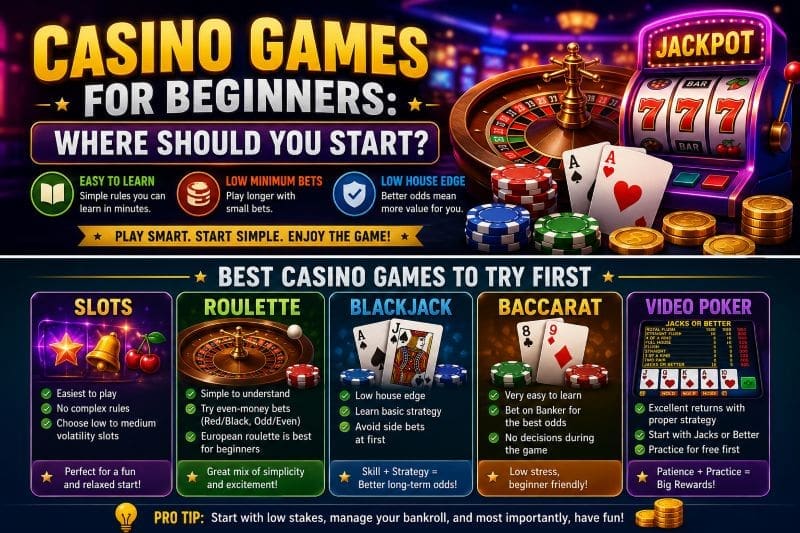
Casino games generally fall into a small number of different categories, and being able to quickly identify the characteristics of each category will help you make a well-informed decision about where you should be placing your bets. There are literally thousands of slot machines available to play at an online casino. Slot machines do not require any strategy, and the results of each individual spin are completely independent of every other spin. As such, slot machine Return To Players (RTPs) can vary greatly from game to game, with some having RTPs in excess of ninety-five percent (95%) and others having RTPs of less than twenty percent (20%). While this variance is the primary attraction to slot machines due to the sheer variety of themes, bonus rounds, and jackpots, it is also what makes slots so detrimental to the player. Online Blackjack is the game in which you have the greatest degree of control over any casino game since your decisions (i.e., whether to Hit, Stand, Double Down, or Split) directly impact the final result of the game. When played utilizing Basic Strategy (which is simply a set of decisions based on your initial two-card hand value and/or your knowledge of the dealer’s exposed card), the House Edge for Online Blackjack drops below fifty percent (50%).
Online Roulette is simple to describe: you place a wager on where you believe the ball will land on a spinning wheel. Of course, European Single-Zero Wheel Roulette is significantly better for players than American Double-Zero Wheel Roulette. Baccarat appears complex; however, it is arguably one of the easiest casino games to play. The only decisions you need to make are whether to wager on the Banker Hand or the Player Hand. The Banker Hand has a built-in House Edge of approximately 1.06%.
Live Dealer Versions of Each of These Games Exist – And Experienced Players Really Love Them
As indicated above, there are live dealer versions of all three casino games discussed above. Although these games were designed for the experience of playing against a live dealer and interacting with their environment and mannerisms in real-time via video feed technology, they have become extremely popular among experienced casino players who miss this aspect of traditional casino environments.
What Does A Proper Responsible Gambling Framework Look Like?
In jurisdictions where gambling regulations require licensed casinos to provide players with responsible gambling tools, these tools are typically much more effective than most new players would imagine. Deposit Limits limit how much money a player can add to their account daily, weekly or monthly. Loss Limits prevent a player from losing more than a certain predetermined amount during a specified period. Reality Checks alert players periodically as to how long they’ve been engaged in gameplay. Self Exclusion prevents players from accessing their accounts for a time period they establish – from weeks to years. The key piece of advice here is to establish these limits prior to engaging in play; doing so after losing money is substantially more difficult. Establishing your bankroll prior to play allows you to remain calm and rational when setting your budget.
Responsible Gaming Resources
Organizations like GamCare and BeGambleAware provide confidential assistance without judgment to anyone struggling with compulsive behavior related to gambling. Similar programs exist in multiple markets including the U.K.’s GamStop program, which allows consumers to self-exclude themselves from all participating operators simultaneously as opposed to operator-by-operator.
Selecting Your First Casino
Ultimately, selecting your first online casino is dependent upon several variables that work collectively. Ideally you’ll select a casino that holds a license issued by a reputable regulatory authority like the UKGC or MGA. Next, ensure that the casino offers a significant number of recognized games from quality game developers that publish RTP information for public review. Also, check that there are sufficient accepted payment options available for use within your geographical area without any additional transactional charges associated with such deposits. Prior to accepting any kind of welcome promotion read carefully through its terms and conditions. Specifically focus on both the wagering requirements as well as which types of games contribute towards meeting those requirements. Additionally, many experienced players suggest trying demo mode at your selected casino before risking any money. Most slot machines and numerous table games permit free-play with virtual currency allowing you to gain an appreciation for how the game functions along with how frequently various bonus features occur as well as whether or not you personally enjoy the way that game plays. Any casino that prohibits attempting games for free or otherwise pressures you into funding an account before giving you a chance to view everything around you is communicating something about their overall business practices.
To summarize, for beginning players there are essentially three elements that combine together: Understanding how the mathematical models operate behind each casino game, Reading through all terms prior to agreeing to anything, Verifying that your chosen casino has appropriate licensure and regulation in place. Anything beyond these core elements are simply details atop these core fundamentals.